
Evolve Peptides GHK-Cu: 50mg or 100mg?
Evolve Peptides GHK-Cu comes in 50mg and 100mg vials, and it is also part of the GLOW and KLOW blends. This guide covers what GHK-Cu is, what the research found and which option fits your study.
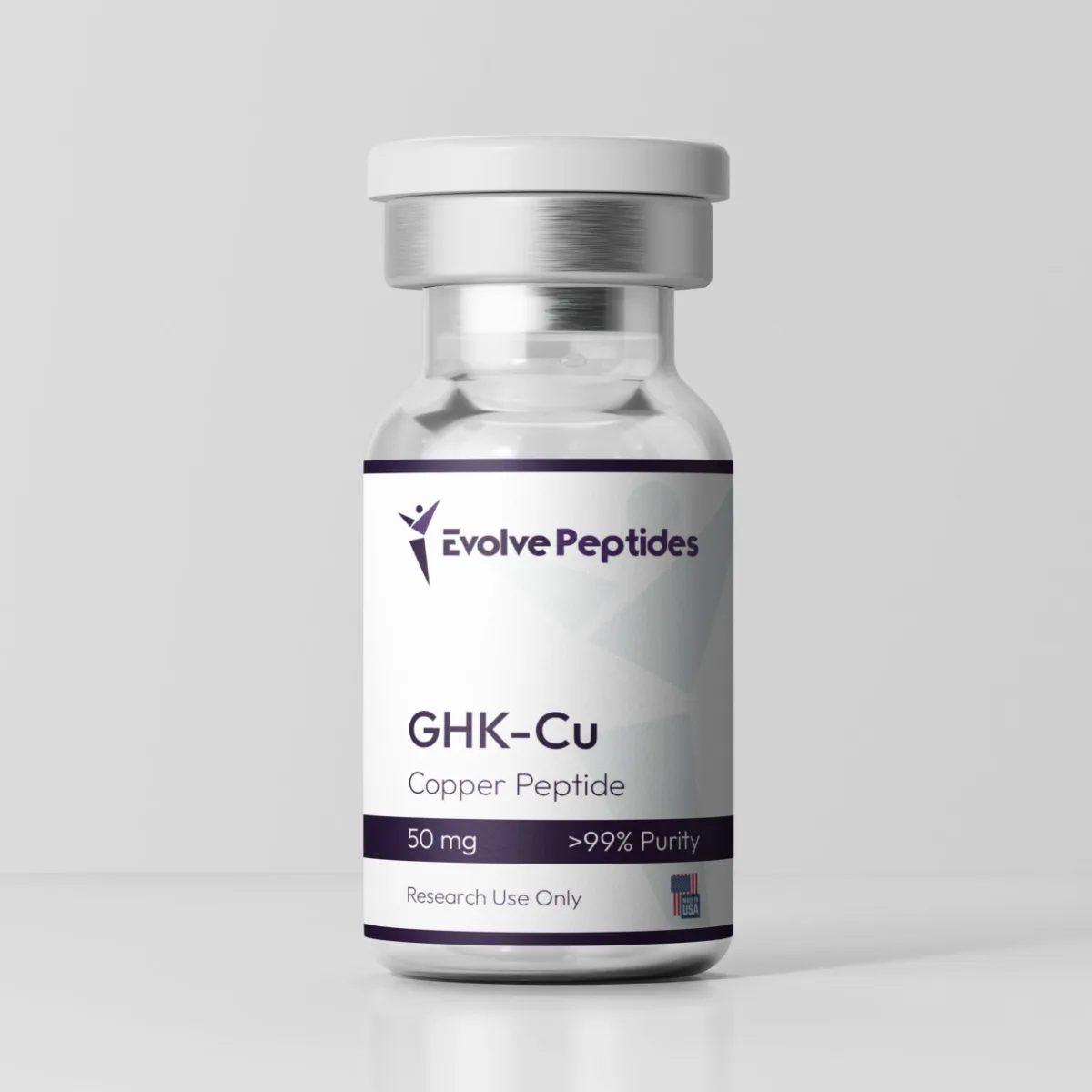
What is Evolve Peptides GHK-Cu?
GHK-Cu is the tripeptide glycyl-histidyl-lysine bound to a copper ion. Loren Pickart first reported GHK in human plasma in 1973, and levels of it fall with age. Our vials hold lyophilized GHK-Cu for laboratory research, and the powder is blue because of the copper.
Evolve Peptides GHK-Cu sizes and prices
- GHK-Cu 50mg: $65.00, about $1.30 per mg
- GHK-Cu 100mg: $109.90, about $1.10 per mg
Both vials go a long way, since GHK-Cu is usually reconstituted at a few milligrams per ml. The 100mg vial is the better value if you’ll use it within about four weeks of mixing.
GHK-Cu blends
- GLOW Peptide Blend 50mg: $135.00
- GLOW Peptide Blend 70mg: $185.00
- KLOW Peptide Blend 80mg: $282.00
GLOW combines GHK-Cu with BPC-157 and TB-500, and KLOW adds KPV as a fourth peptide. They’re the simplest way to cover copper peptide and repair research in one vial. See all peptide blends.
GHK-Cu research highlights
Lab and animal studies link GHK-Cu to collagen and elastin production, wound remodeling and the activity of hundreds of genes involved in tissue repair. Pickart has published reviews of the research over several decades. For the papers, start with this PubMed search for GHK-Cu.
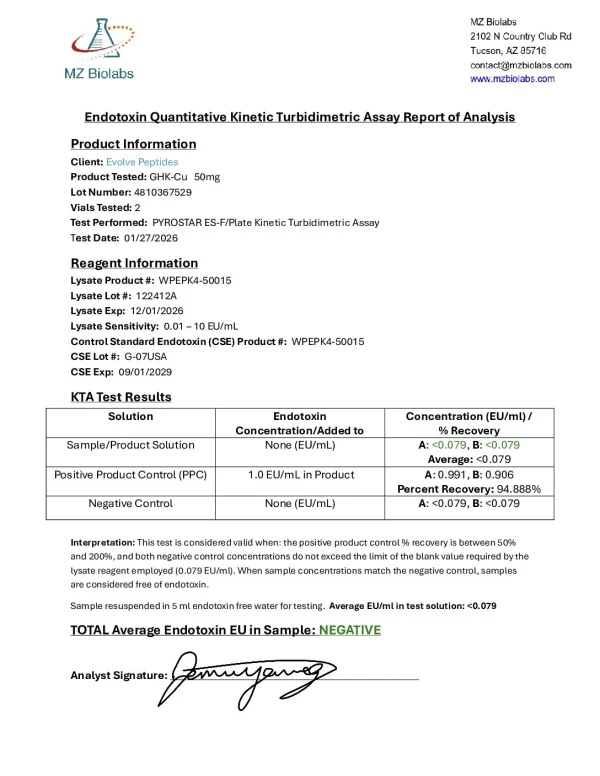
Lab reports for Evolve Peptides GHK-Cu
The GHK-Cu 50mg listing shows an endotoxin report from a kinetic LAL assay in the photos. Our lab testing page explains what each report measures.
Reconstituting Evolve Peptides GHK-Cu
GHK-Cu dissolves easily in bacteriostatic water. A 50mg vial with 5ml gives 10mg/ml, and a 100mg vial with 5ml gives 20mg/ml. The solution is blue because of the copper. Swirl gently, label the vial with the concentration and date, and keep it in the fridge.
Storing GHK-Cu
Keep sealed vials cold and out of light. Once mixed, refrigerate and use within about 28 days. A vial box or a dark corner of the fridge does the job.
GHK-Cu or AHK-Cu?
Both are copper tripeptides. GHK-Cu has decades of skin and wound research behind it. AHK-Cu swaps glycine for alanine and is studied mostly in hair follicle cells. If your work is on skin or collagen, GHK-Cu is the usual starting point.
Evolve Peptides GHK-Cu in blends or on its own?
Buy GHK-Cu on its own when copper peptide is the only thing you’re studying, or when you need to control the amount precisely. Pick a blend when your work also covers repair peptides: GLOW 70mg holds 50mg of GHK-Cu with 10mg each of BPC-157 and TB-500, and KLOW 80mg adds 10mg of KPV.
Related skin peptides
Researchers working on skin often look at AHK-Cu, the copper peptide studied in hair follicle cells, and at Argireline and SNAP-8. See the full skin peptides range.
Evolve Peptides GHK-Cu FAQ
Which is better value, 50mg or 100mg?
The 100mg vial, at about $1.10 per mg against $1.30 for the 50mg.
Is GHK-Cu lab tested?
Yes. The GHK-Cu 50mg photos show an endotoxin report from a kinetic LAL assay.
Why is the powder blue?
The copper ion gives GHK-Cu its blue color. That’s normal.
Is GHK-Cu for human use?
No. It’s sold for laboratory research only.
Buy GHK-Cu 50mg from Evolve Peptides
In stock in 50mg and 100mg, plus the GLOW and KLOW blends.
All Evolve Peptides products are sold for laboratory research use only. They are not for human or veterinary use and have not been evaluated by the FDA.