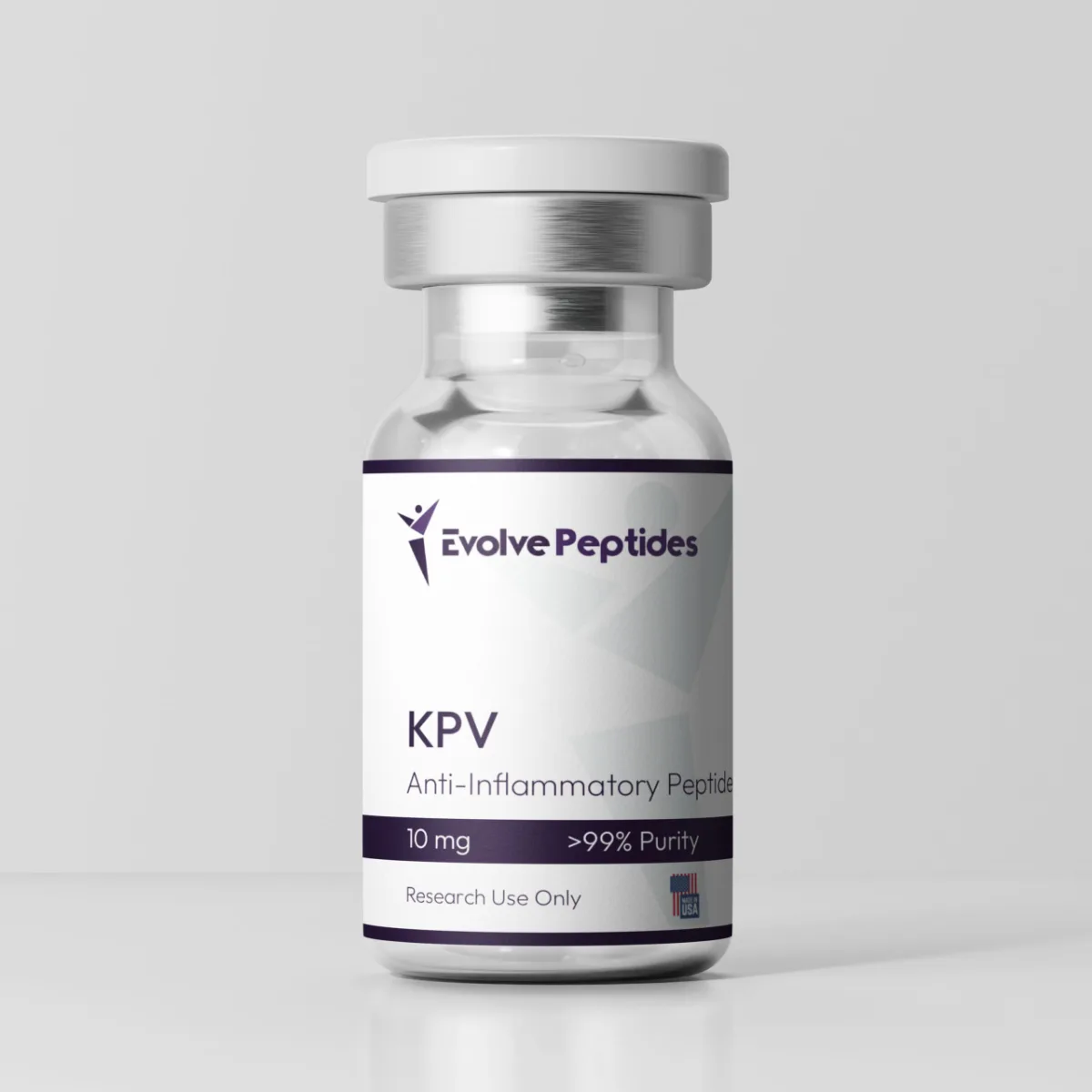
Description
Our KPV 10mg vial holds 10mg of lyophilized KPV, an alpha-MSH derived tripeptide. It’s sold for laboratory research only.
About KPV
KPV is the tripeptide lysine-proline-valine, the C-terminal end of alpha-melanocyte stimulating hormone. It keeps alpha-MSH’s anti-inflammatory activity without the pigment effects.
It’s small enough to be taken up by gut cells through the PepT1 transporter, which is why it’s studied in models of gut inflammation.
How KPV works
Alpha-MSH calms inflammation through melanocortin receptors. KPV is its last three amino acids and keeps much of that anti-inflammatory activity.
Inside cells it lowers NF-kappaB signaling, the switch for many inflammatory genes. Gut cells take it up through the PepT1 transporter, which is why colitis models are where most of the work is.
KPV 10mg technical data
- Compound: KPV
- Also known as: Lys-Pro-Val
- CAS number: 67727-97-3
- Molecular formula: C16H30N4O4
- Molar mass: 342.4 g/mol
- Sequence: Lys-Pro-Val
- Amount: 10mg per vial
- Form: lyophilized (freeze-dried) powder
- SKU: EVP-KPV-10
- Use: laboratory research only
KPV research
Dalmasso and colleagues reported in Gastroenterology (2008) that KPV reduced inflammation in mouse colitis models and was taken up through PepT1.
Laroui and colleagues later packaged KPV in nanoparticles and saw similar effects in mice.
The primary literature is on PubMed. Here’s a search for KPV studies to start from.
How to reconstitute KPV 10mg
The volume of water you add sets the concentration. For a vial holding 10mg:
- 1ml of bacteriostatic water gives 10mg/ml
- 2ml of bacteriostatic water gives 5mg/ml
- 3ml of bacteriostatic water gives 3.33mg/ml
Pick the volume that keeps your own calculations simple, then write the concentration and the mixing date on the label.
Most labs use bacteriostatic water. Let the vial reach room temperature, run the water slowly down the inside of the glass, then roll it gently until the powder dissolves. Don’t shake it. Shaking can shear peptide chains.
Storage and shelf life
Store sealed vials in the fridge (2 to 8°C) or freezer (-20°C), away from light. Mixed solution goes back in the fridge and should be used within about 28 days.
KPV purity and lab testing
We’ve put the lab paperwork for KPV 10mg in the image gallery:
- A certificate of analysis with identity, measured quantity and HPLC purity. The Chromate reports also cover sterility and heavy metals.
- An endotoxin report from a kinetic LAL assay.


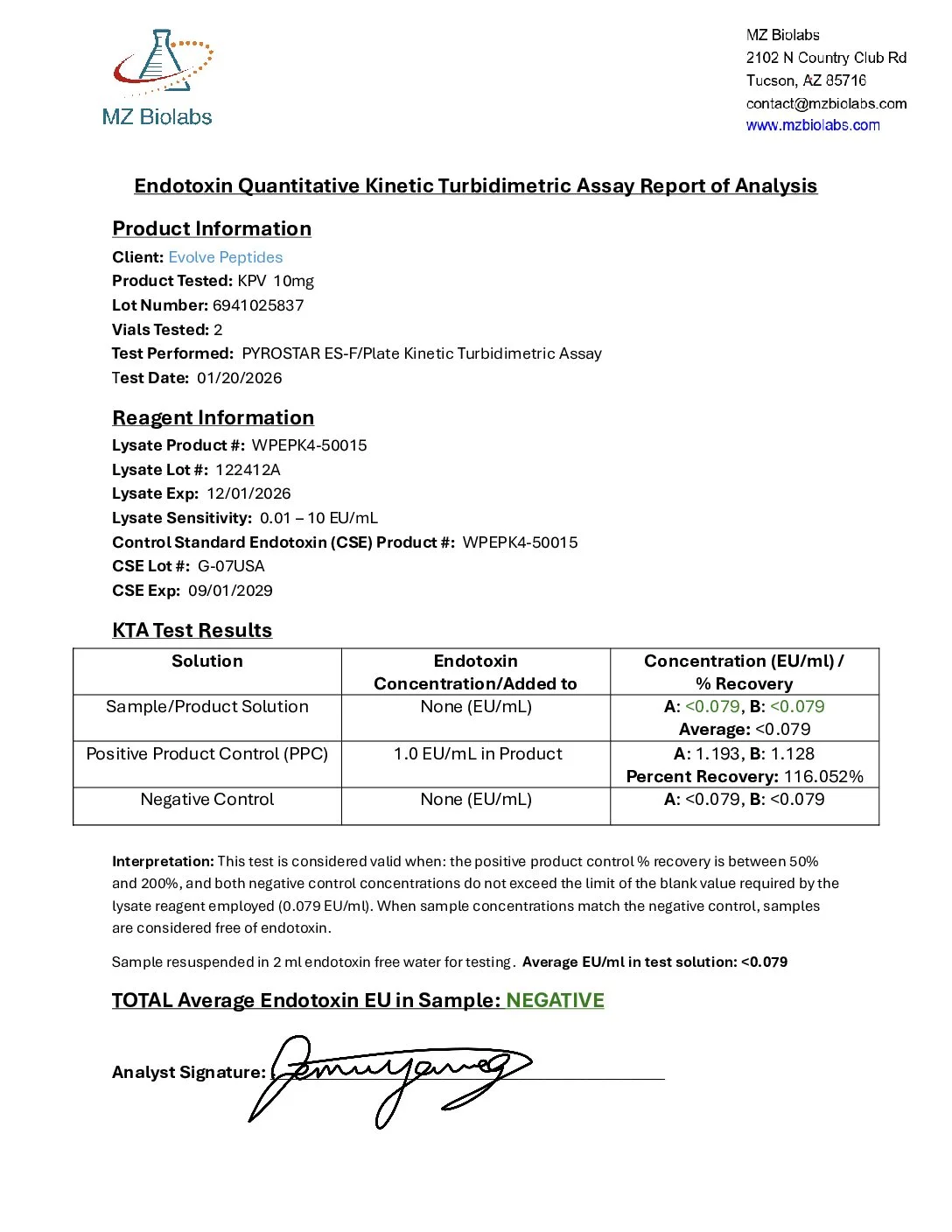
Click any image to zoom in on the numbers. Some of these reports were run on a different vial size of KPV from the same production. The purity figure carries over; the quantity line refers to the vial that was tested.
Choosing a KPV size
- KPV 5mg: 5mg for $40.00, about $8.00 per mg
- KPV 10mg (this page): 10mg for $60.00, about $6.00 per mg
For longer projects KPV 10mg works out cheapest per milligram, and you’ll reorder less often.
Peptides often ordered with KPV
- KPV Capsules 500mcg, 60 capsules
- BPC-157 15mg, 15-amino-acid peptide
- Thymosin Alpha-1 5mg, thymic peptide
- LL-37 2mg, antimicrobial peptide
- TB-500 10mg, thymosin beta-4 peptide
Browse the full healing and recovery peptides range, or see every vial on our research peptides page.
Common questions about KPV 10mg
How much is in the KPV 10mg vial?
10mg of lyophilized powder. The amount is printed on the label.
How should I store it?
Sealed vials go in the fridge, or the freezer for long-term storage. Once mixed, refrigerate and use within about 28 days.
Can KPV be used in people or animals?
No. It’s sold for laboratory research only and isn’t approved for human or veterinary use.
Is it in stock?
Yes, KPV 10mg is in stock now.
Is KPV 10mg lab tested?
Yes. The lab reports are in the product photos, so you can check purity before you order.
Order KPV 10mg today
Ready to order? KPV 10mg costs $60.00 and is in stock. Add it to your cart and you’re done. Add a vial of bacteriostatic water if you don’t have any, so you’re ready to reconstitute when it arrives.
Need more for the same project? See the rest of our healing and recovery peptides.
For laboratory research use only. Not for human or veterinary use. Not evaluated by the FDA.


Reviews
There are no reviews yet.